
Trying a No-Registration Demo Before Real-Money Play: Sweet Bonanza

A demo can be a practical way to understand a slot’s layout, symbols and bonus mechanics before deciding whether real-money play is appropriate. For readers comparing options, the sweet bonanza game can be examined with virtual credits when the hosting website provides a free-play mode. That access is separate from casino registration, account verification and payments. A demo does not create a casino account, prove that a particular operator is suitable, or remove the financial risks associated with gambling.
What does a demo without registration actually provide?
A no-registration demo normally loads the slot with virtual credits rather than withdrawable money. The player can spin, observe wins and losses, and become familiar with the interface without entering personal information into the game itself. Access is controlled by the website hosting the demo, so the absence of a registration requirement is a feature of that website, not an independent account offered by the game developer.
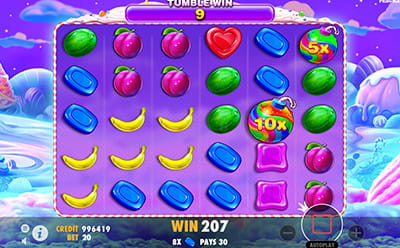
The original version uses a 6×5 grid and a Pay Anywhere system. A win requires at least eight matching paying symbols anywhere on the grid, rather than along conventional fixed paylines. Winning symbols disappear, symbols above fall into the vacant spaces and new symbols enter from the top. This Tumble process can create several wins from one paid spin, which is easier to understand in a demo than from a short written description.
Demo play can also show how the lollipop Scatter works and how the Free Spins round is presented. Four or more Scatters trigger the feature in the documented version, which normally begins with 10 free spins. Additional Scatters can award five more spins, while multiplier bombs may appear during the feature. These observations are useful for learning the rules, but virtual results do not predict future real-money results.
Which details should you check before relying on the demo?
Not every demonstration uses identical settings. The casino version may have a different RTP configuration, stake range, currency or enabled feature from another version found online. The in-game information screen is therefore the most relevant place to check the rules for the specific version being viewed. Published figures should not be treated as universal when operators can select different configurations.
Pay particular attention to whether the demo includes the same options that might appear in real-money play. An Ante Bet or Double Chance-style option may increase the stake by 25% and add Scatter symbols, while Bonus Buy, where permitted, may cost 100 times the selected base bet. Either feature can be disabled by the operator or unavailable under applicable local rules, so seeing it in a demonstration does not establish that it will be offered later.
The distinction between the built-in Free Spins feature and casino promotions is also important. Free Spins triggered by Scatters are part of the slot’s rules. Promotional free spins supplied by a casino are separate and may have expiry dates, wagering requirements, maximum-bet restrictions or game-contribution terms. A demo cannot show how a particular promotion affects withdrawals, because those conditions belong to the operator’s agreement.
How can a short trial improve your decision?
Use the demo as an information exercise rather than a test of luck. Start by reading the paytable and checking the minimum and maximum stake shown by the interface. Then play enough rounds to see how the grid, Tumbles, Scatters and feature screens operate. You do not need to chase a large virtual balance or continue until a bonus round appears; neither outcome provides evidence about future performance.
A useful trial can answer practical questions. Is the visual pace comfortable? Are the symbols easy to distinguish on a phone? Does the sound distract you? Can you find the rules and game-history controls? If Autoplay is available, do you understand its stop conditions, including balance changes, a feature trigger or a selected win? If these controls feel unclear, real-money play should not be treated as the next step.
Keep a clear boundary between learning and spending. Do not increase a real stake because the demo produced a favourable sequence, and do not try to recover a disappointing virtual result by switching to cash play. Short sessions are not statistically meaningful, and a demonstration cannot confirm an RTP, volatility pattern or maximum win. Its value is limited to familiarity with the mechanics and interface.
What does “without registration” not cover?
Demo access may avoid registration, but real-money play requires an account with the casino hosting the slot. That account may involve an email address, password, personal information and confirmation of the applicable legal-age requirement. The slot itself has no separate player login, registration process or identity-check system.
Verification is likewise handled by the operator. Before a withdrawal, a casino may ask for government-issued photo identification, proof of address or evidence that a payment method belongs to the account holder. These requirements are not removed because the player first used a demo. They may also affect how quickly an account can be used for real-money activity, so the operator’s stated requirements should be read in advance.
Payments are outside the game as well. The slot does not process deposits or withdrawals, and a demo balance has no cash value. Account currency, available payment methods, fees, withdrawal limits and processing conditions depend on the casino. Availability can also differ by province, operator and account. Do not assume that a website offering a demo also offers real-money play, CAD support or every feature shown in the demonstration.
Which safeguards should accompany a demo decision?
A demo is most useful when it helps you decide whether to stop, not when it becomes a rehearsal for spending more. Before any real-money session, establish a fixed entertainment budget and a time limit that you can afford to lose. Treat the budget as an expense, never as income or a source of repayment. If the limit is reached, ending the session is the intended result.
Check which controls the hosting operator provides before depositing. These may include deposit or loss limits, session reminders, cooling-off periods and self-exclusion. Their availability and operation are controlled by the casino and may depend on the rules applying in your province. The game’s own stake and Autoplay controls are not substitutes for account-level protections.
For broader information about gambling-related harms and support, consult Canada’s Centre for Addiction and Mental Health. Warning signs can include chasing losses, hiding gambling, borrowing to continue, repeatedly exceeding a budget or feeling unable to stop. If a demo increases urges rather than improving understanding, skip real-money play and consider using stronger account restrictions or seeking confidential support.
Questions readers often ask about demo access
Can I use the demo and later withdraw its virtual balance?
No. Demo credits are virtual and have no cash value. They cannot be converted into winnings or transferred to a casino account. Withdrawals, where available, concern real-money balances held by the operator, and those balances may be subject to identity checks and the casino’s stated terms.
Does a demo show the exact results I will receive for money?
No. Each spin is an individual random event, and a short demonstration cannot predict future outcomes. It may show the slot’s rules, symbols and features, but it cannot prove a particular RTP, establish a winning pattern or indicate when a bonus round will occur.
Why might the real-money version differ from the demo?
The operator may use a different RTP configuration, stake range or currency, and some options can be disabled by the casino or local rules. Bonus Buy and Ante Bet availability may vary as well. Read the loaded game’s information screen and the operator’s terms before making assumptions.
 My friends call me Hoppy and I have something in common with every one of you... a heart beat and only 168 hours a week to juggle family, work, household duties and exercise, which includes gardening!
Come with me on a journey to health and wellbeing that is not only good for you, but for the Earth too.
Personal Trainer | Thermomix Consultant | Urban Permaculture | Mum